Nike Spent Over 4 Years Making Sure the GT Future was Built Different
PublishedQuick Facts
- Sole Retriever presents an exclusive breakdown behind the creation of the Nike GT Future
- Jason Petrie and Jarrett Mann broke down all the details in a conversation with Sole Retriever at Nike's WHQ in Beaverton
- Find exclusive images and our full conversation below
This content may contain affiliate links. If you make a purchase through these links, we may earn a commission.

Over the last half-decade, Nike has released dozens of basketball models with a design language and DNA that all feel very similar. That’s not to say they don’t perform well on the court, they do. But much of the lineup doesn't necessarily stand out among the crowd. Low-top Kobe-esque designs have dominated the Nike Basketball landscape for years, but the innovation and forward-thinking design that defined Nike Basketball in the late ‘90s and early 2000s felt like a distant memory. As it turns out, Nike agreed internally, and this turning point led to the creation of the revolutionary GT Future.
Nike invited Sole Retriever to HQ in Portland to dive deep into the archive and learn about the game-changing new basketball silhouette and how their team brought it to life, including exclusive looks at early references and upcoming colorways. We were fortunate to spend some time with the global vice president of Nike Basketball footwear, Jarrett Mann, and director of innovation, basketball footwear product design, Jason Petrie, for unprecedented access behind-the-scenes of the GT Future.

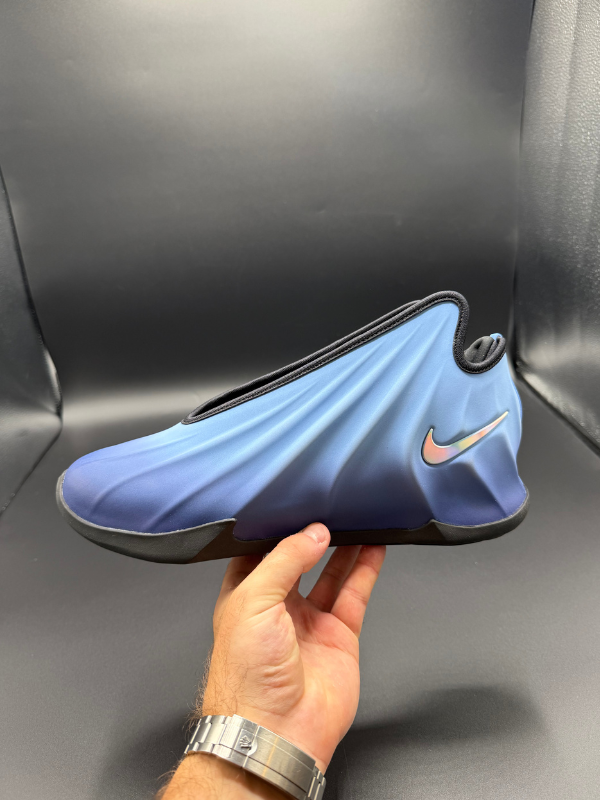
If you haven’t yet peeped the extraterrestrial-looking sneaker, the low-cut GT Future (yes, it’s a low-cut) features an internal bootie surrounded by a Foamposite shell. Although not explicitly mentioned during our conversation with Jason Petrie and Jarrett Mann, the GT Future clearly draws some inspiration from the Zoom Hyperflight, a performance basketball sneaker originally released in 2001 and expected to return in 2026. The Future’s Foamposite material comes with wavy striations that extend across the upper like wrinkles in the fabric of the universe. Internally, the sole unit features full-length Zoom Strobel, Zoom Air units in the forefoot, and Cushlon 3.0 foam throughout.
When asked to describe the Nike GT Future in one word, BYU star and consensus top NBA draft pick AJ Dybantsa told Sole Retriever, “different.” That’s actually not too far off from what Nike had in mind during the four-year development cycle of the sneaker. AJ got the memo.
“I think the word ‘different’ is almost tantamount to how we started the whole process,” said Jason Petrie. “Like, wanting to have a different feel underfoot, wanting to have a different design expression.”

Petrie joined Nike in 2003 and would go on to design every LeBron James signature sneaker from the LeBron 7 to the LeBron 22. In April of this year, he became the director of innovation at Nike Basketball and oversees virtually all of the work done in the basketball division. Jarrett Mann has been Team Swoosh since 2017, and in September, assumed the role of global VP of basketball footwear, having previously served as senior director of men’s global basketball footwear.
Creating the GT Future

Ideation for the Nike GT Future began in 2020 inside Nike’s Advanced Research NXT group. At that point in time, it was merely a concept meant to springboard into something more tangible, though it wouldn’t be that long until focus shifted to creating what would become the GT Future.
As Nike and the rest of the world began to trickle back into the office following the pandemic in 2022, the GT Future became one of the first projects Nike Basketball tackled. Rather than iterating on existing GT products, the team approached the Future as a project to explore, which allowed the team to discover where the next generation of basketball products could go. “The original insight was, how do you make somebody feel that notion of elevation?” said Pietre. “We always talked about the joy of being a kid and just running and bouncing around. I can't believe how floaty and fun this thing feels to wear.”

Image via foot_doctor_zach
The fun and bouncy feeling the GT Future provides underfoot comes from the three different technologies embedded in the cushioning setup. A full-length Zoom Strobel, which is essentially a Zoom Air unit stitched into the Strobel board of the shoe, combines with full-length Cushlon 3.0 foam and forefoot Zoom Air units. Once you put it on, you’ll notice how the feeling is surprising coming from a sneaker that seemingly has no midsole.
A typical sneaker takes around 18 months to complete, from initial sketch to being in the hands of consumers, but the Future was nearly four years in the making. When asked how far off from the original design concepts the retail version of the model is, Jason Petrie explained that the original ideas are a “complete 180. Let's say, 170 degrees, from the original design expression.”
Sample images via Sole Retriever
Foamposite material was not even in the minds of the design team initially, but testing different iterations of the concept led them toward the technology. Some versions used the textile material pictured above. You might think, “Why would Nike want to look to the past for a sneaker that’s meant to represent the future?” And hey… not a bad question. But really think about Foamposite as a material. It’s one of Nike’s most forward-thinking technologies. The liquid-molded polyurethane foam creates a seamless, one-piece shell that doesn’t succumb to creasing, stretching, or loss of structure like traditional stitched-leather uppers often do.
Coming to the consensus of using Foamposite, while helping solidify what the sneaker would become, presented a heap of new challenges. Petrie shared that there were plenty of highs and lows during the testing phase of various GT Future iterations. “There was some pushing and pulling as we changed the construction just to get people to wear it. Definitely had people coming out of it very early like, ‘I can't play in this. It either feels unsafe or it's hurting my ankle.’”
A ton of time and effort went into addressing feedback given to the design team, from tweaking the cut of the ankle collar to reconstructing the internal bootie for a more secure and contained fit. While tooling and internal tech were a focal point, the team also made sure the GT Future passed the eye test. “If you solve the problem and it's not beautiful, you haven't done your job.” Petrie also mentioned reactions to some samples were as harsh as “Whoa, hell no,” but gradually every sample round would come back with improvements.
Something that stood out to the team was the groups of people who were excited about what the GT Future was becoming. It was an eclectic mix of tastemakers, design crews, hippies, hoopers, and more, but each had distinct styles. “The design team that was working on it started to see it was people willing to be a little different who are into this. That's exactly what we're trying to make.”
Sketches from Jason Petrie
Sometimes it can be hard to put your finger on the exact vibe of the GT Future. It’s futuristic, man-made, and engineered, but there’s something that just seems so… organic and natural. Those wavy lines on the upper that jet across the Foamposite material, or as Jason calls it, “shotgun purse.” That’s something seen on a lot of ‘90s basketball models using synthetic materials like this, and it gets its name from how these seams and lines resemble the rounded profile of a shotgun barrel. “These aren't computer-done. This is me laying them in there like that. That's kind of why they look a little bit more natural on this very engineered piece.” They give the Future’s upper something akin to muscle.
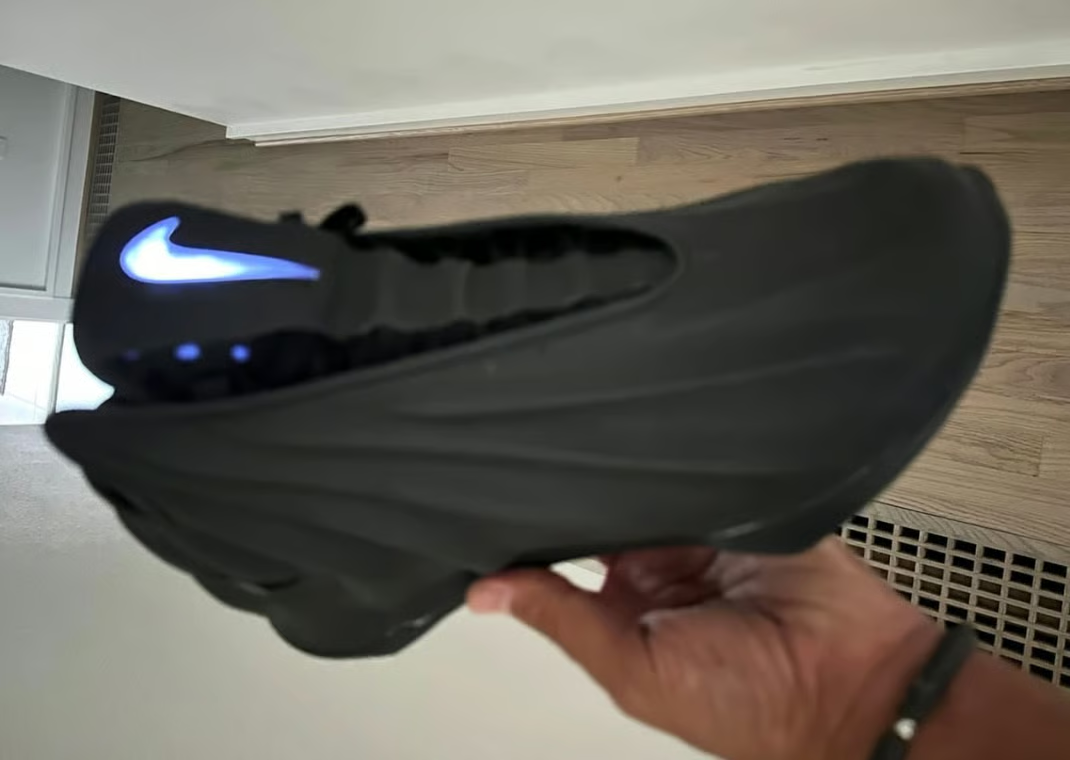
Image via Jason Petrie
In early samples worn by Wale and AJ Dybantsa, the Swoosh on the tongue even featured LED lights. Not really something that would be ideal for mass production and performance use, but the idea originated from Jason’s love for Robert Zemeckis’ legendary Back to the Future franchise. “I'm a MAG freak. I'm here probably because of that moment in that movie.” In Back to the Future Part II, Marty McFly heads to the far-off year of 2015, arriving in an era where Nike has self-lacing shoes. Nike created a replica version of the sneaker in 2011, but in 2016 actually released an ultra-limited run of self-lacing Nike MAGS, and to this day, those sneakers fetch upwards of $50,000.
While that feature didn’t make the final cut, one element that was brought up in early think-tanks was UFO landing lights. The GT Future incorporates the theme of UFOs with small circular cut-outs on the outsole as a callout to these beams of light. But they do serve a double purpose. Not only are they a neat Easter egg but they also reduce the weight of the sneaker. “Nobody's ever going to know that story except for me, and hopefully all your readers now.”
Petrie has been with Nike for over 20 years, so he’s seen his fair share sneakers that caused mixed reactions. “This is the most polarizing one.” He mentions the project could have been killed or redirected and turned into a “normal shoe to fill a gap,” but there was a core group who believed in the sneaker from the very beginning. “I'm just really proud of the category, the design leadership, basketball leadership. They saw something early in it and kept the wolves at bay. That allowed the team to nurture this project.”
Internally, the sneaker was looked at by its believers as a “future style icon,” which led the team to design the “craziest build, craziest benefit, craziest material” to assemble an “arresting form.” The brief was to “make us uncomfortable,” which Petrie confirmed “We don't care if 90% of the people don't like it. That's actually what we want to hear. Cause if you don't like it, that means you're uncomfortable.” He harkened the sneaker to a proverbial middle finger. “I’ll choose to just make you either hate it, love it, come back to it, turn away.”
Molded by the Past

Even decades removed from its initial introduction via the Nike Air Foamposite One, the material still looks like something from the future. “I think Foamposite has captivated every generation since this came out,” said Petrie. “I mean, I remember losing a very enjoyable relationship at the time because I spent too much money on a pair of bright blue sneakers, as opposed to this individual. But I still have those sneakers. I don't talk to that person.”
Outside of the connection Foamposite has to the sneaker world and on-court performance, the tech allows for new iterations that derive from the same manufacturing base. Petrie praised the material and how it’s still relevant today, stating, “You can create new things today [with Foamposite] because it was just so wide open.” That's exactly what the team did with the GT Future, refusing to be stagnant.

“A lot of the world transitioned to wearing low top, Kobe-esque builds. We wanted to kind of zig when everybody else was zagging,” said Petrie. It’s quite clear the Future is Nike swinging the pendulum in the opposite direction, something that may be a turning point for the industry as a whole. It’s something that, at the moment, is very divisive. Going through online discourse around the model, there really is not a camp that sits in the middle or thinks the model is “just fine.” They’re either all-in or out entirely. And that’s something Nike perfected in the ‘90s and early 2000s.
This author was not around for the days of Jesus Shuttlesworth lacing up the Pearl Foamposite Pros in He Got Game, or old enough to have a conscious understanding of how important Jason Kidd or Jason Williams were to the cult-classic Flightposite and Hyperflight in the early 2000s, but it’s clear these sneakers all stood out among what other competitors were putting out.
Ok, maybe you can make a case for adidas pushing the envelope forward with some of the adidas Kobe models, but those don’t hold a candle to the cultural significance of the Foamposite family. Other ‘90s basketball models from brands like Reebok, Fila, and Converse definitely had a common thread in terms of design language. Colors that popped, wild exaggerated paneling and even proportions in some cases, but they primarily stuck to traditional manufacturing methods. They were all clearly evolutions of previous basketball sneakers, whereas Nike’s output within its Alpha Project design initiative were lightyears ahead of the rest of the market.
Formally launched in 1999, the Nike Alpha Project spawned a wide range of sneakers across multiple categories, not just basketball. Models that fall under the initiative would often feature a five-dot logo somewhere on the design or the packaging. One famous TV spot for the Alpha Project was directed by Michael Bay (yes, the guy who makes everything explode in Transformers and Armageddon), which featured Gary Payton and a slew of other athletes. Fun fact: Years before Jason Petrie joined Nike, his username on NikeTalk was ALPHAPROJECT, where he would share concepts that would have been perfect for the design initiative.
We could spend hours dissecting all of the wonderful (and maybe not-so-wonderful) sneakers that resulted from the Alpha Project, but let’s keep it brief and save that discussion for another time. Outside of basketball, models that dropped under the Alpha Project initiative include the Air Kukini, Air Presto, Air Zoom Citizen, Air Rift, Air Zoom Talaria, and dozens more. On the basketball side of things, you have the Hyperflights and Flightposites of the world, the former of which clearly inspired the GT Future. Specifically, the winged structure around the collar is nearly identical on both sneakers.

Image via oneoftheoriginalogs
Color executions from models like the Foamposite are primarily why the model remains popular today and continues to be as impactful as it is. Very few sneakers transcend traditional sneaker culture, but the monolithic status of the Foamposite made headlines when riots would break out over the Galaxy pair, or the ultra-limited run of ParaNorman Foams that now fetch thousands of dollars on the aftermarket. Foamposites, and now the GT Future, occupy a rare space where color ceases to be something decorative to the sneaker itself.
The material applications of Eggplant or copper/chrome versions of the sneaker just can’t be replicated with traditional leather and suede builds and will forever be associated with the sneakers. Just because a sneaker uses black, red, and white colors does not always conjure up images of the Chicago Jordan 1. But if a shoe has an iridescent eggplant purple shine? That’s the Foamposite.

While we can’t share all of the details of what to look forward to in terms of color applications on the GT Future, what’s been previewed so far can give you an idea of what is possible. Frank Cooke, the legendary footwear industry veteran who rejoined Nike in September 2024, has been one of the leading figures sharing images of the GT Future. References to previous Foamposite and Hyperflight colorways, like the Copper Eggplant and Varsity Red, were shared by Frank in early 2025.
When asked if the GT Future was the start of a new era for Nike Basketball’s innovation, Jason Petrie was quick to respond, “100%.” He continued, “I think you can start seeing that bleed out now, you know, like not every shoe is going to be some big massive form like this, but the holistic nature of the design, the storytelling, and making sure every form and silhouette is compelling.”
Like the Foamposite and Alpha Project sneakers, the GT Future is something that will certainly impact new models from Nike. Maybe not with direct sequels, but certainly in how it has pushed the company’s design teams to be radical and boundary-pushing once again. The GT Future is a state of mind.
The Wale Effect
It might not seem right that we’ve only mentioned Wale twice so far. Well, that’s because he deserves his own section. As the D.C. native and former Virginia State football player’s music career took off in the mid-2000s, one of his early hits was actually about a Nike sneaker. Well… boots, to be specific. The song “Nike Boots” was Wale’s homage to the Air Max Goadome model, a cult classic in the DMV. Alongside Goadomes, Wale and others from the region were constantly championing the Air Foamposite and giving fans a how-to guide to styling them off-court.
The most famous moment from this era, and probably the most discussed, was Wale’s appearance in a Dime Magazine print ad for the streetwear brand LRG. A Nike employee was hooking up Wale with early pairs of sneakers, and the rapper decided to bust one in particular out for this photoshoot that inadvertently debuted the now iconic Eggplant Foamposite to the world. Maybe that’s not giving Wale or Nike enough credit on the strategic front. Could have totally been on purpose.

When the ad went live in October 2008, forums like NikeTalk were filled with discussion on this new colorway of the Foamposite One. At the time, Foams were very much a regional sneaker for the DMV, despite what your favorite NYC sneakerhead tries to tell you, but Wale helped spark renewed interest in Foams for a whole new generation of sneakerheads.
The Eggplant Foams wouldn’t hit shelves for a few more months, but demand was so high that after it sold out in 2009, a restock took place in 2010. We’d get two more retro releases of the Eggplant Foams, once in July 2017 and most recently in February 2024.
Wale would continue to wear Nike Foams and Nike Boots throughout the 2010s, but nothing would quite hit the same like Wale’s LRG ad. Later in 2024, Nike quite literally gave Wale and the DMV their flowers with a special colorway of the Air Foamposite One.
The DMV Cherry Blossom colorway was an ultra-limited release that was exclusive to DMV-area retailers. Inspired by the cherry blossom trees found throughout Washington, D.C., the pair features a light pink Foamposite upper and contains insole graphics with a cherry blossom branch against a sky blue backdrop. Technically, it’s not a “Wale x Nike” release, but he was featured heavily in the promo of the sneaker. His first official Nike collab would come at the end of 2025 in celebration of his album "everything is a lot." That would be on a friends-and-family colorway of the Nike Air Max Goadome.

Images via higherlxng
Then came the Nike GT Future. Nike was hosting the Nike Future Game in San Francisco for NBA All-Star Weekend 2025, and AJ Dybantsa dropped 16 points in the model. His blacked-out version of the sneaker was a much more subtle debut compared to the pair that Wale was wearing on the sidelines. Wale’s bright orange version of the sneaker, which is nearly identical to the 1-of-300 Fire colorway that dropped at NY vs. NY in August, sent the online sneaker community into a frenzy.
Discussion surrounding Nike’s “lack of innovation” was hitting a high point around the time of the GT Future’s unveiling. But seeing Wale rock that bright orange pair was the perfect moment for the brand. Wale was able to add that extra “cool” factor to the model that only he could as a notorious Foamhead. Whether or not Nike initially planned on having the rapper be the de facto face of the GT Future we may never know, but going forward he was almost exclusively the one to debut new colorways.
On March 16th, Wale would post a photo on his Instagram teasing the release of a new single, “Blanco,” while sporting a pair of blue GT Futures. At the time, we had no idea, but this was an early sample version of his very own Valor Blue colorway that was recently released. Over the following weeks and months, he would debut a Volt pair, an Electric Green colorway, and a Metallic Orange pair.
Outside of the aforementioned Fire colorway, which was limited to a pre-order release at Nike’s NY vs. NY streetball tournament, and a limited release at Concepts for the Metallic Silver pair, the Wale x Nike GT Future was the first opportunity the public had at copping the model. The silhouette comes coated in a blue gradient that is coated entirely in 3M for a reflective finish, with iridescent Swoosh logos found on the lateral and medial sides.

Jason Petrie shared with us that Wale requested the iridescent logos as an homage to the Nike Total Foamposite Max, a sneaker famously worn by Tim Duncan. “For me, the beauty was paying respect to the person who kind of put the shoe in the bag. The team was very adamant about it. Let’s stay true to him.”
The sneaker was released on December 13th exclusively in the DMV area. Even in freezing temperatures, fans lined up outside a Hillcrest Heights, Maryland Foot Locker for hours for a chance to cop the sneaker and meet Wale. Two days later without warning, Nike would shock drop the sneaker on the SNKRS app via a SNKRS Code. Within 5 minutes, virtually every size was sold out. It left fans who missed out feeling like everything is a lot.
Nike’s handling of the GT Future, from its internal briefs to the rollout with Wale and AJ Dybantsa, is restoring the feeling Nike Basketball brought to the scene in the early 2000s. Obviously, using Foamposite and giving it that forward-thinking design language prevalent throughout the Alpha Project is more than enough. But tying it together with a cultural tastemaker like Wale and a basketball prodigy like AJ? That’s something only Nike Basketball could achieve.
There’s finally some major momentum behind Nike Basketball. Now, they’ve just got to keep building on it. That’s something that’s already looking promising with sneakers like the GT Cut 4, and if the GT Future marks the start of a new era like Jason Petrie stated, expect more sneakers to lean into this design language. Unfortunately, the debut Metallic Silver pair sold out with the quickness, but more colors are expected to launch over the coming months. Hopefully you can score a pair in the Future.
Sneakerhead from South Florida who turned his passion into a career. When not writing for Sole Retriever, I enjoy watching films and discovering music. Follow me on Letterboxd @nickvlah For tips, reviews, or any shoes in a size 13, email nick@soleretriever.com